

SBI Funds Management IPO Review 2026: Price Band, Financials, Valuation & Should You Apply?
India’s largest asset management company is set to enter the stock market with one of the biggest public offerings of 2026. SBI Funds Management Limited, the investment manager of SBI Mutual Fund, has launched its ₹11,692.91 crore Initial Public Offering (IPO), offering investors an opportunity to own a stake in one of India’s leading financial services companies.
Backed by State Bank of India (SBI) and Amundi Asset Management, SBI Funds Management has built a strong position in the Indian mutual fund industry through its extensive distribution network, diversified investment products, and consistently growing Assets Under Management (AUM). As of March 31, 2026, the company managed one of the largest mutual fund portfolios in the country, serving millions of investors across equity, debt, hybrid, ETF, PMS, AIF, and advisory segments.
Unlike many IPOs that raise fresh capital for expansion, this issue is entirely an Offer for Sale (OFS). This means the proceeds from the IPO will go to the existing selling shareholders, while the company itself will not receive any funds from the public issue. Investors should therefore evaluate the IPO primarily on the company’s business fundamentals, market leadership, financial performance, growth prospects, and valuation.
With a price band of ₹545–₹574 per equity share, a minimum investment of ₹14,170, and an issue size exceeding ₹11,692 crore, the IPO has attracted significant attention from both retail and institutional investors. However, an important question remains:
Is SBI Funds Management IPO worth applying for, or is the valuation already pricing in its future growth?
In this detailed IPO review, Arthneeti Global analyses every important aspect of the issue, including:
- IPO details and subscription timeline
- Company profile and business model
- Industry outlook
- Financial performance
- Competitive strengths
- Key risk factors
- Valuation analysis
- Peer comparison
- Long-term growth prospects
- Final investment outlook
Whether you are applying for listing gains or considering a long-term investment, this article will help you understand the key opportunities and risks associated with the SBI Funds Management IPO.
SBI Funds Management IPO 2026: Key Highlights
| Particulars | Details |
|---|---|
| IPO Type | Book Built Issue |
| Issue Size | ₹11,692.91 Crore |
| Issue Structure | 100% Offer for Sale (OFS) |
| Price Band | ₹545–₹574 per share |
| Face Value | ₹1 per equity share |
| Lot Size | 26 Shares |
| Minimum Investment | ₹14,170 |
| IPO Opens | 14 July 2026 |
| IPO Closes | 16 July 2026 |
| Basis of Allotment | 17 July 2026 |
| Refunds / Fund Unblocking | 17 July 2026 |
| Tentative Listing Date | 21 July 2026 |
| Listing Exchange | NSE & BSE |
What Does This IPO Mean for Investors?
The SBI Funds Management IPO provides investors with an opportunity to participate in the growth of India’s rapidly expanding asset management industry. As household savings increasingly shift towards mutual funds and other financial assets, asset management companies are expected to benefit from higher Assets Under Management (AUM) and recurring fee-based income.
However, investors should also consider important factors such as the IPO valuation, competitive landscape, dependence on market performance, and regulatory environment before making an investment decision.
In the following sections, we examine whether SBI Funds Management’s market leadership and financial strength justify its valuation and whether the IPO offers attractive long-term potential.

About SBI Funds Management Limited
Before evaluating whether the SBI Funds Management IPO is worth applying for, it is important to understand the company’s business, market position, and long-term growth potential.
SBI Funds Management Limited (SBIFML) is one of India’s leading asset management companies (AMCs) and serves as the investment manager for SBI Mutual Fund. Incorporated in 1992, the company has played a significant role in the growth of India’s mutual fund industry for more than three decades.
The company is promoted by State Bank of India (SBI), India’s largest public sector bank, and Amundi Asset Management, one of Europe’s largest asset management companies. This strategic partnership combines SBI’s extensive domestic banking network with Amundi’s global investment expertise, enabling the company to serve millions of investors across India.
Over the years, SBI Funds Management has expanded beyond traditional mutual funds and now offers a diversified range of investment solutions, including Portfolio Management Services (PMS), Alternative Investment Funds (AIFs), Specialized Investment Funds (SIFs), advisory services, and offshore investment products.
As of 31 March 2026, the company managed approximately ₹16.32 lakh crore in Assets Under Management (AUM), representing around 15.5% of India’s mutual fund industry AUM. During the same period, it served more than 18 million unique investors, making it one of the country’s largest and most trusted investment managers.
Company Profile
| Particular | Details |
|---|---|
| Company Name | SBI Funds Management Limited |
| Incorporated | 1992 |
| Industry | Asset Management |
| Business | Investment Manager of SBI Mutual Fund |
| Promoters | State Bank of India & Amundi |
| Headquarters | Mumbai, Maharashtra |
| IPO Type | 100% Offer for Sale (OFS) |
| Listing | NSE & BSE (Proposed) |
Who Owns SBI Funds Management?
SBI Funds Management is jointly promoted by two globally recognised financial institutions:
State Bank of India (SBI)
State Bank of India is India’s largest commercial bank with an extensive branch network and a trusted brand built over decades. SBI provides the company with a strong domestic distribution network, enabling it to reach investors across metropolitan cities as well as Tier-II and Tier-III locations.
Amundi Asset Management
Amundi is one of the world’s leading asset managers with operations across Europe, Asia, and other global markets. Through this partnership, SBI Funds Management benefits from international investment expertise, global research capabilities, and best practices in asset management.
The combination of SBI’s domestic reach and Amundi’s global experience has been a key factor behind the company’s sustained growth and leadership in India’s asset management industry.
What Does SBI Funds Management Do?
Unlike manufacturing or technology companies, SBI Funds Management does not manufacture products or sell physical goods. Instead, it manages investors’ money by investing in financial assets such as equities, bonds, money market instruments, and other securities.
The company earns recurring income by charging management fees based on the Assets Under Management (AUM) across its investment products.
Its core business includes:
- Mutual Funds
- Portfolio Management Services (PMS)
- Alternative Investment Funds (AIFs)
- Specialized Investment Funds (SIFs)
- Advisory Services
- Offshore Investment Management
This asset-light, fee-based business model enables the company to generate stable and recurring revenue while benefiting from the long-term growth of financial savings in India.
Why Is SBI Funds Management Important?
SBI Funds Management has established itself as one of the most influential players in India’s investment ecosystem. Some of its key achievements include:
- One of India’s largest asset management companies by Quarterly Average Assets Under Management (QAAUM).
- More than 18 million unique investors served across the country.
- A diversified portfolio comprising 128 mutual fund schemes across equity, debt, hybrid, ETF, index, and other categories.
- Leadership in passive investment products, including ETFs and index funds.
- A nationwide distribution network supported by banks, independent financial advisors, distributors, and digital investment platforms.
- Strong brand recognition backed by SBI and Amundi.
Why Is This IPO Significant?
The SBI Funds Management IPO is not just another public offering—it represents an opportunity for investors to participate in the growth of India’s rapidly expanding asset management industry.
As more Indian households shift their savings from traditional assets such as gold and real estate toward financial products like mutual funds, the industry is expected to witness sustained long-term growth.
With its established market leadership, trusted brand, diversified investment offerings, and recurring fee-based business model, SBI Funds Management is well positioned to benefit from this structural trend.
However, investors should also evaluate the company’s valuation, competitive landscape, and key business risks before making an investment decision.
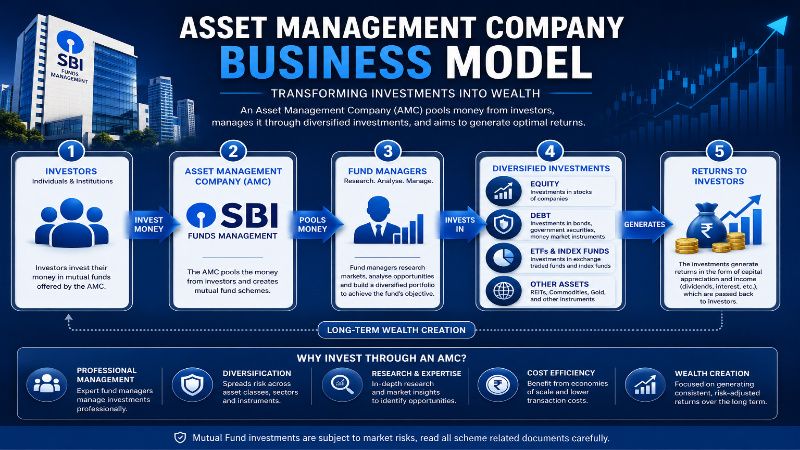
Business Model: How SBI Funds Management Earns Money
Understanding the business model is essential before investing in any company. Unlike manufacturing companies that generate revenue by selling products, or banks that primarily earn income through lending activities, SBI Funds Management Limited operates an asset-light, fee-based business model. Its earnings are directly linked to the amount of money it manages on behalf of investors rather than the performance of any single investment.
The company serves as the investment manager for SBI Mutual Fund and manages investments across multiple asset classes, including equity, debt, hybrid funds, exchange traded funds (ETFs), index funds, portfolio management services (PMS), alternative investment funds (AIFs), and advisory mandates.
How Does SBI Funds Management Generate Revenue?
The company’s primary source of income is investment management fees, which are charged as a percentage of the Assets Under Management (AUM). As investor assets increase through fresh investments and market appreciation, the company’s fee income generally rises.
Its major revenue sources include:
- Management fees from mutual fund schemes
- Portfolio Management Services (PMS) fees
- Alternative Investment Fund (AIF) management fees
- Advisory and investment management services
- Offshore fund management and international mandates
- Other investment-related services
Since these revenues are recurring in nature, the business enjoys greater earnings visibility compared with companies that rely on one-time sales.
Understanding the Asset Management Business
The asset management process can be simplified into the following stages:
Step 1: Investors Invest
Retail investors, institutions, corporates and high-net-worth individuals invest money into various SBI Mutual Fund schemes based on their financial goals and risk appetite.
Step 2: Funds Are Pooled
The investments from thousands of investors are pooled into professionally managed mutual fund schemes.
Step 3: Investment Management
Experienced fund managers invest these pooled funds across equities, bonds, money market instruments and other securities in accordance with each scheme’s investment objective.
Step 4: Assets Under Management (AUM) Grow
As fresh investments continue and the value of investments appreciates over time, the total Assets Under Management increase.
Step 5: Fee-Based Income
The company earns recurring management fees based on the AUM, creating a scalable business model where revenue can grow without requiring significant capital investment.
Why Is the Asset Management Business Attractive?
Asset management is often regarded as one of the most attractive segments within financial services because it combines scalability with recurring revenue.
1. Asset-Light Business
Unlike infrastructure or manufacturing companies, asset managers do not require substantial investment in factories, machinery or physical assets. Growth is primarily driven by attracting more investor assets.
2. Recurring Revenue
Management fees are earned continuously as long as investors remain invested, providing relatively predictable income streams.
3. High Operating Leverage
As Assets Under Management expand, revenue can increase faster than operating expenses, supporting healthy operating margins.
4. Strong Cash Generation
The business typically requires limited capital expenditure, allowing a significant portion of earnings to convert into operating cash flows.
5. Long-Term Industry Tailwinds
India’s mutual fund industry continues to benefit from increasing financial literacy, rising SIP participation, digital investing and growing household allocation towards financial assets. These structural trends support long-term growth for established asset managers.
Product Portfolio
SBI Funds Management offers a broad range of investment solutions catering to different investor needs.
Equity Funds
Designed for investors seeking long-term capital appreciation through investments in listed companies.
Debt Funds
Focus on fixed-income securities such as government bonds, treasury bills and corporate debt, generally offering lower volatility than equity funds.
Hybrid Funds
Invest across both equity and debt instruments to balance growth and stability.
Exchange Traded Funds (ETFs)
Provide passive exposure to market indices and are traded on stock exchanges like listed shares.
Index Funds
Track benchmark indices such as the Nifty 50 or Sensex with the objective of replicating index performance.
Portfolio Management Services (PMS)
Offer customised investment portfolios for high-net-worth individuals and institutional investors.
Alternative Investment Funds (AIFs)
Provide access to specialised investment strategies that are generally available to sophisticated investors.
Advisory and Offshore Investment Services
The company also provides investment advisory services and manages overseas investment mandates, expanding its presence beyond the domestic mutual fund business.
What Drives Future Growth?
The long-term growth of SBI Funds Management depends on several structural factors:
- Rising Systematic Investment Plan (SIP) contributions.
- Increasing financialisation of household savings.
- Growing adoption of mutual funds in Tier-II and Tier-III cities.
- Expansion of passive investing through ETFs and index funds.
- Higher participation by institutional investors.
- Digital investment platforms simplifying investor onboarding.
- Increasing retirement and pension-related investments.
These trends could support continued growth in Assets Under Management, which in turn may contribute to higher management fee income over time.
Why This Business Model Matters for Investors
For investors evaluating the IPO, the business model is one of SBI Funds Management’s strongest attributes. The combination of recurring fee income, limited capital requirements, strong brand recognition and long-term industry growth provides a foundation for sustainable business expansion.
However, investors should also remember that the company’s revenue is linked to Assets Under Management. Prolonged market downturns or significant investor outflows can affect fee income, making market conditions an important factor in future financial performance.
India’s Mutual Fund Industry: A Long-Term Structural Growth Story
The long-term growth prospects of SBI Funds Management are closely linked to the expansion of India’s mutual fund industry. As one of the country’s largest asset management companies, the business is well positioned to benefit from increasing financial awareness, rising household participation in capital markets, and the gradual shift from traditional savings instruments to market-linked investments.
Over the past decade, India’s mutual fund industry has transformed significantly. Factors such as digital investing platforms, higher disposable incomes, improved financial literacy, and the growing popularity of Systematic Investment Plans (SIPs) have encouraged millions of first-time investors to participate in financial markets.
Despite this rapid growth, India’s mutual fund penetration remains relatively low compared with many developed economies. This indicates that the industry still has significant room for expansion over the coming decades.
Growth Drivers of India’s Mutual Fund Industry
Several structural trends continue to support the long-term outlook of the industry.
1. Rising Financialisation of Household Savings
Traditionally, Indian households have preferred investing in physical assets such as gold, real estate and fixed deposits. However, changing investor preferences are gradually shifting household savings towards financial assets, including mutual funds.
This transition has been supported by greater awareness of long-term wealth creation and the convenience of investing through digital platforms.
For asset management companies such as SBI Funds Management, this represents a significant opportunity to attract new investors and increase Assets Under Management (AUM).
2. Strong Growth in SIP Investments
Systematic Investment Plans (SIPs) have become one of the most popular investment methods among retail investors.
Monthly SIP contributions have increased consistently over the past few years as investors adopt disciplined long-term investing instead of attempting to time the market.
For asset management companies, SIPs provide relatively stable and recurring inflows, improving visibility of future Assets Under Management and management fee income.
3. Digital Transformation of Investing
Technology has fundamentally changed how investors access financial products.
Today, investors can complete Know Your Customer (KYC) formalities, invest in mutual funds, monitor portfolios and redeem investments entirely through digital platforms.
SBI Funds Management has strengthened its digital capabilities through its own investment platforms while also leveraging the extensive digital ecosystem of the State Bank of India.
This enhances customer acquisition while improving operational efficiency.
4. Expansion Beyond Metro Cities
One of the most important developments in recent years has been the rapid increase in mutual fund participation from Tier-II and Tier-III cities.
Improved internet connectivity, greater financial awareness and wider distribution networks have enabled asset management companies to reach investors beyond traditional metropolitan markets.
SBI’s nationwide banking network provides SBI Funds Management with a significant advantage in expanding its presence across semi-urban and rural India.
5. Increasing Preference for Passive Investing
Investor interest in passive investment products such as Exchange Traded Funds (ETFs) and Index Funds has increased steadily.
These products generally offer lower costs, greater transparency and performance linked to benchmark indices.
SBI Funds Management has established a strong presence in passive investing, positioning the company to benefit from this evolving investment trend.
Competitive Position of SBI Funds Management
The Indian asset management industry includes several established players, including:
- HDFC Asset Management Company
- Nippon India Asset Management
- ICICI Prudential Asset Management
- UTI Asset Management Company
- Aditya Birla Sun Life AMC
- Kotak Mahindra Asset Management
Despite strong competition, SBI Funds Management continues to maintain a leadership position due to several competitive advantages.
Market Leadership
The company is India’s largest asset management company by Quarterly Average Assets Under Management (QAAUM), reflecting its scale and strong investor confidence.
Strong Brand Recognition
The SBI brand enjoys widespread trust among retail and institutional investors, helping the company attract new customers and retain existing ones.
Extensive Distribution Network
The company benefits from one of India’s largest financial distribution ecosystems through SBI branches, independent financial advisors, distributors, banks and digital investment platforms.
Diversified Investment Solutions
Unlike companies that focus primarily on mutual funds, SBI Funds Management offers a diversified suite of investment products, including:
- Mutual Funds
- Exchange Traded Funds (ETFs)
- Index Funds
- Portfolio Management Services (PMS)
- Alternative Investment Funds (AIFs)
- Advisory Services
- Offshore Investment Solutions
This diversified product portfolio helps reduce dependence on any single revenue source.
Industry Challenges
Although the long-term outlook remains positive, the asset management industry also faces several challenges.
Market Volatility
Revenue is linked to Assets Under Management, making earnings sensitive to fluctuations in financial markets.
Regulatory Changes
The industry is regulated by the Securities and Exchange Board of India (SEBI). Changes in regulations relating to expense ratios, commissions or product structures may affect profitability.
Intense Competition
The industry has become increasingly competitive, with established players and new entrants investing heavily in technology, product innovation and customer acquisition.
Shift Towards Passive Products
The growing popularity of passive investment products could put pressure on management fees over time, requiring AMCs to focus on scale and operational efficiency.
Arthneeti Global Insight
The long-term outlook for India’s asset management industry remains favourable. Rising financial literacy, increasing SIP participation, digital investing and the gradual shift of household savings towards financial assets are expected to support sustained industry growth over the coming years.
Given its market leadership, trusted SBI brand, diversified investment offerings and extensive distribution network, SBI Funds Management is well positioned to benefit from these structural trends. However, sustained success will depend on its ability to maintain investment performance, attract new investors, adapt to evolving regulations and compete effectively in an increasingly dynamic asset management landscape.
SBI Funds Management Financial Performance
A company’s financial performance is one of the most important indicators of its long-term investment potential. For an asset management company, investors should focus not only on revenue and profit growth but also on operational efficiency, profitability, and the ability to generate recurring income from Assets Under Management (AUM).
SBI Funds Management has delivered consistent growth across its core financial metrics over the last four financial years. According to the Red Herring Prospectus, the company has benefited from expanding AUM, improving operating leverage and disciplined cost management, resulting in strong growth in both revenue and profitability.
Revenue Analysis
The company’s operating revenue has increased consistently over the past four financial years.
| Financial Year | Operating Revenue (₹ Crore) | YoY Growth |
|---|---|---|
| FY23 | 2,161.59 | — |
| FY24 | 2,690.56 | 24.5% |
| FY25 | 3,597.76 | 33.7% |
| FY26 | 4,389.49 | 22.0% |
Source: Red Herring Prospectus
Arthneeti Global Analysis
Operating revenue has grown from ₹2,161.59 crore in FY23 to ₹4,389.49 crore in FY26, representing a CAGR of 26.6% over the period. This growth has been supported by higher Assets Under Management (AUM), continued investor inflows, and expansion across the company’s asset management franchise.
Unlike cyclical businesses, SBI Funds Management benefits from recurring management fees, making revenue growth relatively stable as long as AUM continues to expand.
Profit After Tax (PAT)
Strong revenue growth has translated into improving profitability.
| Financial Year | PAT (₹ Crore) | YoY Growth |
|---|---|---|
| FY23 | 1,339.71 | — |
| FY24 | 2,072.79 | 54.7% |
| FY25 | 2,540.15 | 22.6% |
| FY26 | 3,067.38 | 20.8% |
Source: Red Herring Prospectus
Arthneeti Global Analysis
Profit after tax has more than doubled over the last four financial years. The company reported a 31.8% CAGR in PAT between FY23 and FY26, reflecting strong operating leverage and disciplined cost management. SBI Funds Management also remained among the top profit-generating AMCs in India during FY26.
This consistent earnings growth indicates that the company has successfully converted rising AUM into higher profits.
Profitability Analysis
One of the defining strengths of an asset management business is its ability to scale without proportionately increasing costs.
The RHP highlights that SBI Funds Management’s profitability ratios have improved steadily during FY24–FY26:
- Operating revenue as a percentage of QAAUM increased to 0.35%.
- Operating profit as a percentage of QAAUM improved to 0.28%.
- PAT as a percentage of QAAUM reached 0.25% in FY26.
Why This Matters
Improving profitability ratios suggest that the company is generating more earnings from each rupee of assets it manages. This reflects better pricing power, operational efficiency, and scale.
Cost Efficiency
SBI Funds Management has consistently improved its cost structure.
| Financial Year | Cost-to-Income Ratio |
|---|---|
| FY23 | 26.6% |
| FY24 | 22.0% |
| FY25 | 20.6% |
| FY26 | 19.5% |
Source: Red Herring Prospectus
Arthneeti Global Analysis
A declining cost-to-income ratio indicates that expenses are growing more slowly than revenue. The RHP notes that SBI AMC reported one of the lowest cost-to-income ratios among major listed AMCs, supported by operating leverage and the ability to leverage SBI’s infrastructure for investor servicing, KYC processing and payment systems.
For investors, this is a positive sign because it suggests that future revenue growth could continue to translate into healthy profit growth.
Revenue Quality
Another notable strength is the company’s dependence on its core business rather than non-recurring income.
In FY26:
- 85.1% of total income came from management fees, underscoring the stability of its revenue profile and limited reliance on non-core income.
Arthneeti Global Analysis
A high share of management fee income is generally viewed positively because it reflects recurring earnings generated from managing client assets rather than one-off gains.
Return on Equity (ROE)
Return on Equity measures how efficiently a company generates profits from shareholders’ capital.
According to the RHP:
- SBI Funds Management reported an ROE of 43.0% in FY26, the second-highest among major peer AMCs, reflecting strong profitability and efficient capital utilisation.
Arthneeti Global Analysis
An ROE above 40% is exceptional for a financial services company and indicates that SBI Funds Management has been highly effective in generating earnings from its equity base. However, investors should compare this with listed peers at the time of the IPO to assess whether the valuation appropriately reflects this profitability.
Financial Performance Summary
The company’s financial performance highlights several encouraging trends:
Positives
- Consistent double-digit revenue growth.
- Strong PAT CAGR over FY23–FY26.
- Improving operating leverage.
- Declining cost-to-income ratio.
- High recurring management fee income.
- Strong return on equity.
- Scalable, asset-light business model.
Key Watchpoints
- Revenue remains linked to market performance and AUM growth.
- A prolonged equity market downturn could reduce management fee income.
- Sustaining high profitability will depend on continued investor inflows and disciplined cost management.
Why SBI Funds Management Stands Out
SBI Funds Management has established itself as one of India’s leading asset management companies through a combination of market leadership, strong brand recognition, an extensive distribution network, diversified investment offerings, and disciplined execution.
According to the Red Herring Prospectus, the company has built a competitive position that is supported by its parentage, scale, technology investments, and long operating history. These advantages have enabled it to consistently grow its Assets Under Management (AUM), improve profitability, and maintain its position among the country’s largest asset managers.
1. India’s Largest Asset Management Company by QAAUM
One of SBI Funds Management’s biggest strengths is its scale.
The company is the largest asset management company in India by Quarterly Average Assets Under Management (QAAUM), giving it significant advantages in terms of brand recognition, operational efficiency, and market presence.
A larger AUM allows the company to:
- Spread fixed costs over a broader asset base.
- Improve operating efficiency.
- Offer a wider range of investment products.
- Invest more in technology and research.
- Strengthen its competitive position against smaller AMCs.
This leadership also enhances investor confidence, as many investors prefer established fund houses with a proven track record.
2. Strong Parentage of SBI and Amundi
SBI Funds Management benefits from the combined strengths of two globally recognised financial institutions.
State Bank of India (SBI)
As India’s largest public sector bank, SBI provides:
- A trusted brand.
- One of the country’s largest banking networks.
- Access to millions of existing banking customers.
- Extensive distribution capabilities across urban and rural India.
Amundi Asset Management
Amundi contributes:
- Global investment expertise.
- International best practices.
- Research capabilities.
- Risk management experience.
- Product innovation.
This partnership creates a strong competitive advantage that is difficult for many peers to replicate.
3. Diversified Product Portfolio
SBI Funds Management offers investment solutions across multiple asset classes rather than relying on a single product category.
Its offerings include:
- Equity Mutual Funds
- Debt Mutual Funds
- Hybrid Funds
- Index Funds
- Exchange Traded Funds (ETFs)
- Portfolio Management Services (PMS)
- Alternative Investment Funds (AIFs)
- Advisory Services
- Offshore Investment Solutions
A diversified product portfolio enables the company to cater to different investor profiles and market conditions while reducing dependence on any one segment.
4. Extensive Distribution Network
Distribution remains one of the biggest competitive advantages in the asset management industry.
SBI Funds Management reaches investors through:
- SBI’s nationwide branch network.
- Banks and financial institutions.
- Mutual fund distributors.
- Independent Financial Advisors (IFAs).
- Digital investment platforms.
- Direct online channels.
The SBI banking ecosystem provides the company with access to a large customer base, supporting customer acquisition and long-term growth.
5. Strong Brand Trust
Trust plays a crucial role in financial services.
SBI is one of India’s most recognised banking brands, and this credibility extends to SBI Funds Management. Many investors associate the SBI brand with stability, reliability, and long-term financial security.
Brand trust can contribute to:
- Higher investor retention.
- Easier customer acquisition.
- Stronger SIP inflows.
- Greater resilience during periods of market volatility.
6. Technology-Driven Operations
The company has invested in technology to improve customer experience and operational efficiency.
Its digital capabilities include:
- Online account opening.
- Digital KYC.
- Mobile investment platforms.
- Online transaction processing.
- Investor servicing portals.
- Digital fund management infrastructure.
Technology enables the company to serve a growing investor base while maintaining operational efficiency.
7. Strong Financial Profile
The company’s financial performance further reinforces its competitive position.
Some key strengths include:
- Consistent revenue growth.
- Strong profit growth.
- High Return on Equity (ROE).
- Improving operating margins.
- Declining cost-to-income ratio.
- High share of recurring management fee income.
These characteristics demonstrate the scalability of its asset-light business model.
8. Experienced Leadership and Governance
Managing investor capital requires robust governance and disciplined risk management.
SBI Funds Management benefits from:
- An experienced leadership team.
- Established investment processes.
- Comprehensive risk management frameworks.
- Regulatory oversight.
- Strong corporate governance practices.
These factors help the company maintain investor confidence while navigating changing market conditions.
Arthneeti Global Analysis
SBI Funds Management’s competitive strengths extend beyond its size. Its combination of market leadership, trusted promoters, diversified product offerings, extensive distribution network, and improving operational efficiency creates a strong competitive moat.
However, these strengths do not eliminate investment risks. The asset management industry remains highly competitive, and future growth will depend on the company’s ability to continue attracting investor inflows, maintaining investment performance, and adapting to regulatory and technological changes.
Overall, the company’s competitive position appears well aligned with the long-term structural growth of India’s mutual fund industry.
Key Risks Investors Should Consider Before Applying
Every investment carries risk, and an IPO should not be evaluated solely on the company’s strengths. While SBI Funds Management has established itself as one of India’s leading asset management companies, prospective investors should carefully consider the risks disclosed in the Red Herring Prospectus (RHP) before making an investment decision.
The following are some of the key business and industry risks that could impact the company’s future financial performance.
1. Revenue Depends on Market Performance
One of the biggest risks for any asset management company is its dependence on capital market performance.
SBI Funds Management earns a significant portion of its revenue through management fees, which are linked to Assets Under Management (AUM). During prolonged market corrections or periods of weak investor sentiment, declines in equity markets may reduce AUM due to lower portfolio valuations and investor redemptions. This, in turn, could impact management fee income and overall profitability.
Although the company has a diversified product portfolio, sustained market volatility remains an important business risk.
2. Highly Regulated Industry
The asset management industry in India operates under the supervision of the Securities and Exchange Board of India (SEBI).
Any future regulatory changes related to:
- Expense ratios
- Mutual fund commission structures
- Product categorisation
- Investor protection norms
- Compliance requirements
could affect the company’s revenue, operating costs, and profitability.
As regulations continue to evolve, asset management companies must regularly adapt their business models to remain compliant.
3. Intense Industry Competition
The Indian mutual fund industry has become increasingly competitive over the last decade.
SBI Funds Management competes with several established players, including:
- HDFC Asset Management Company
- Nippon India Asset Management
- ICICI Prudential Asset Management
- UTI Asset Management Company
- Aditya Birla Sun Life AMC
- Kotak Mahindra Asset Management
Competition extends across:
- Investment performance
- Product innovation
- Distribution reach
- Digital capabilities
- Customer acquisition
- Pricing strategies
Failure to maintain competitive investment performance or attract new investors could affect future growth.
4. Dependence on Distribution Network
A substantial portion of the company’s Assets Under Management is sourced through distributors, banks, financial advisors and institutional partners.
Any deterioration in these relationships, changes in distribution regulations, or increased competition for distribution channels may affect investor inflows and future AUM growth.
Although SBI’s banking network provides a significant competitive advantage, maintaining strong distribution partnerships remains essential for long-term growth.
5. Pressure on Management Fees
The Indian mutual fund industry is witnessing increasing adoption of:
- Exchange Traded Funds (ETFs)
- Index Funds
- Passive Investment Products
These products generally charge lower management fees than actively managed mutual funds.
If passive investing continues to grow rapidly, the industry may experience pressure on average management fees, which could affect profitability unless offset by higher AUM growth.
6. Dependence on Investment Performance
Investor confidence depends significantly on the performance of mutual fund schemes.
If a large number of the company’s investment products consistently underperform benchmark indices or competing funds, investors may shift their investments to other asset management companies.
This could result in:
- Lower SIP inflows
- Higher investor redemptions
- Reduced Assets Under Management
- Lower management fee income
Maintaining consistent investment performance is therefore critical for sustaining long-term growth.
7. Technology and Cybersecurity Risks
The asset management industry increasingly relies on digital platforms for:
- Investor onboarding
- Online transactions
- Portfolio management
- Customer servicing
- Data processing
Any major cyberattack, technology failure, or prolonged system outage could disrupt operations, impact customer confidence, and expose the company to financial and reputational risks.
As digital adoption continues to grow, cybersecurity remains an important operational priority.
8. Legal and Regulatory Proceedings
Like many large financial institutions, SBI Funds Management is involved in certain legal and regulatory proceedings disclosed in the Red Herring Prospectus.
Although the company believes these matters may not have a material adverse impact on its operations, unfavourable outcomes could potentially affect its financial position or reputation.
Investors should review the relevant disclosures in the RHP for a detailed understanding of these proceedings.
9. Offer for Sale (OFS) Structure
An important consideration for investors is that the IPO is entirely an Offer for Sale (OFS).
This means:
- The company will not receive any fresh capital from the IPO.
- The proceeds will go to the existing selling shareholders.
- The IPO is intended to facilitate partial stake sales rather than raise funds for business expansion.
While an OFS is common for mature and profitable companies, investors should recognise that the IPO will not directly strengthen the company’s balance sheet or fund future growth initiatives.
Arthneeti Global Analysis
SBI Funds Management’s risk profile is consistent with that of a large, established asset management company. Most of the key risks—such as market volatility, regulatory changes, competition, and fee pressure—are structural risks faced by the entire industry rather than company-specific concerns.
At the same time, the company’s strong market position, diversified product portfolio, extensive distribution network, and experienced management provide meaningful resilience against many of these challenges.
For long-term investors, the focus should remain on whether the company can continue growing its Assets Under Management, maintain investment performance, and adapt to evolving market and regulatory conditions.
IPO Structure, Promoters & Shareholding Pattern
Understanding the IPO Structure
Before applying for any Initial Public Offering (IPO), investors should understand how the issue is structured. An IPO may consist of a Fresh Issue, an Offer for Sale (OFS), or a combination of both.
In the case of SBI Funds Management Limited, the IPO is entirely an Offer for Sale (OFS). This means no new equity shares are being issued by the company, and the proceeds from the IPO will go to the existing selling shareholders rather than the company itself. Consequently, SBI Funds Management will not receive any funds from this public issue for expansion, debt repayment, or other corporate purposes.
For investors, this indicates that the IPO is primarily aimed at providing liquidity and enabling partial stake dilution by the existing shareholders, while the underlying business and capital structure remain unchanged.
Offer for Sale (OFS): What Does It Mean?
An Offer for Sale is a common structure for mature, profitable companies that do not require additional capital for growth.
In a Fresh Issue
- New shares are created.
- The company receives the IPO proceeds.
- Funds may be used for expansion, acquisitions, debt reduction or working capital.
In an Offer for Sale (OFS)
- Existing shareholders sell a portion of their stake.
- No new shares are issued.
- The company does not receive the IPO proceeds.
- There is no dilution due to the creation of additional shares.
Investors should not view an OFS negatively. Many established companies with strong cash generation choose this route because they already have sufficient capital to support their operations.
Who Are the Promoters?
SBI Funds Management is jointly promoted by State Bank of India (SBI) and Amundi Asset Management, combining one of India’s most trusted banking institutions with one of the world’s leading asset managers.
State Bank of India (SBI)
State Bank of India is India’s largest public sector bank and one of the country’s oldest financial institutions. Its nationwide branch network, strong customer relationships, and trusted brand have played a crucial role in the growth of SBI Funds Management.
Through SBI’s extensive banking ecosystem, the company gains access to a wide distribution network and millions of potential investors.
Amundi Asset Management
Amundi is among the world’s largest asset management companies and Europe’s leading asset manager. It brings global investment expertise, international research capabilities, advanced risk management practices, and product innovation to the joint venture.
The partnership between SBI and Amundi combines domestic market reach with global investment knowledge, strengthening the company’s competitive position.
Shareholding Pattern
Prior to the IPO, SBI Funds Management is jointly owned by its promoter entities.
As this IPO is entirely an Offer for Sale, the public issue will reduce the promoters’ shareholding proportionately while increasing public shareholding after listing. The company itself will continue to operate with the same business model and management structure.
Investor Reservation
The IPO has been divided into different investor categories in accordance with SEBI regulations.
| Category | Reservation |
|---|---|
| Qualified Institutional Buyers (QIBs) | 50% |
| Non-Institutional Investors (NIIs) | 15% |
| Retail Individual Investors (RIIs) | 35% |
| Employee Reservation | As specified in the RHP |
This allocation aims to provide balanced participation across institutional, high-net-worth, retail and eligible employee investors.
Employee Discount
The IPO includes a dedicated reservation for eligible employees.
Eligible employees are offered equity shares at a discount to the issue price, recognising their contribution to the company’s long-term growth. According to the announced IPO terms, the employee price band is ₹491–₹520 per share, lower than the general public price band of ₹545–₹574 per share.
IPO Timeline
| Event | Date |
|---|---|
| IPO Opens | 14 July 2026 |
| IPO Closes | 16 July 2026 |
| Basis of Allotment | 17 July 2026 |
| Refunds / Funds Unblocked | 17 July 2026 |
| Shares Credited to Demat | 20 July 2026 |
| Tentative Listing | 21 July 2026 |
Arthneeti Global Analysis
The IPO structure reflects the characteristics of a mature, profitable financial services company. Since SBI Funds Management is not raising fresh capital, investors should evaluate the issue primarily on the strength of its existing business, profitability, market position, and long-term growth prospects rather than expecting immediate expansion funded by IPO proceeds.
The continued presence of State Bank of India and Amundi as promoter shareholders after the IPO also provides confidence regarding business continuity, governance standards, and strategic direction.
Is SBI Funds Management IPO Fairly Valued?
Valuation is one of the most critical factors investors should consider before applying for an IPO. Even a fundamentally strong company may deliver modest returns if it is listed at an aggressive valuation. Therefore, alongside analysing the business, investors should determine whether the IPO pricing fairly reflects the company’s financial performance, market leadership, and long-term growth prospects.
SBI Funds Management is India’s largest asset management company by Quarterly Average Assets Under Management (QAAUM). Backed by State Bank of India (SBI) and global asset manager Amundi, the company enjoys strong brand recognition, a diversified investment platform, and a profitable asset-light business model.
The company has announced its IPO at a price band of ₹545–₹574 per share, implying a market capitalisation of approximately ₹1.17 lakh crore at the upper end of the price band.
Understanding the Valuation
Unlike many IPOs that raise fresh capital for expansion, SBI Funds Management’s IPO is entirely an Offer for Sale (OFS). As a result, the company itself will not receive any proceeds from the public issue. The IPO primarily enables existing shareholders to partially monetise their investment while providing public investors an opportunity to participate in one of India’s leading asset management businesses.
The valuation reflects the company’s existing strengths, including:
- India’s largest AMC by QAAUM.
- Consistent revenue and profit growth.
- High operating margins.
- Strong Return on Equity (ROE).
- Asset-light business model with recurring fee income.
- Trusted parentage through SBI and Amundi.
- Leadership across mutual funds, ETFs, PMS, AIFs and advisory services.
These characteristics typically command premium valuations in the financial services sector.
AMC Peer Comparison
Although SBI Funds Management is yet to be listed, comparing it with established listed Asset Management Companies (AMCs) provides valuable perspective.
Market Position Comparison
| Company | Market Cap (Approx.) | Status | Key Position |
|---|---|---|---|
| SBI Funds Management | ~₹1.17 Lakh Crore (IPO Valuation) | IPO Stage | Largest AMC in India by QAAUM |
| HDFC AMC | ~₹90,000+ Crore | Listed | Leading Retail AMC |
| Nippon India AMC | ~₹43,000+ Crore | Listed | Strong Retail & ETF Franchise |
| Aditya Birla Sun Life AMC | ~₹17,000+ Crore | Listed | Diversified Asset Manager |
| UTI AMC | ~₹13,000+ Crore | Listed | Established AMC |
Valuation Comparison
| Company | Approx. P/E* | Approx. P/B* | Remarks |
|---|---|---|---|
| SBI Funds Management | To be determined after listing | To be determined after listing | IPO valuation based on issue price |
| HDFC AMC | ~40x | ~12x | Premium valuation |
| Nippon India AMC | ~35x | ~10x | Strong profitability |
| Aditya Birla Sun Life AMC | ~22x | ~6x | Moderate valuation |
| UTI AMC | ~18x | ~3x | Relatively lower valuation |
Note: The peer valuation multiples are approximate and may change with market movements. SBI Funds Management’s market-traded valuation ratios will become available after listing.
Competitive Position Against Listed Peers
Compared with its listed peers, SBI Funds Management enjoys several structural advantages:
- Largest Quarterly Average Assets Under Management (QAAUM) in India.
- Strong SBI banking distribution network.
- Global investment expertise through Amundi.
- Diversified investment product portfolio.
- Consistent revenue and profit growth.
- High operating efficiency.
- Strong digital investment ecosystem.
- Established brand with a large retail investor base.
These strengths support the company’s premium positioning within the Indian asset management industry.
Does the IPO Justify a Premium Valuation?
Premium valuations are generally justified when a company demonstrates:
- Market leadership.
- Sustainable profitability.
- High return ratios.
- Strong corporate governance.
- Scalable asset-light business model.
- Long-term industry growth opportunities.
SBI Funds Management meets many of these criteria. India’s mutual fund industry continues to benefit from increasing financialisation, rising SIP inflows, higher retail participation, and growing awareness of long-term investing. As one of the country’s leading AMCs, the company is well positioned to benefit from these structural trends.
However, investors should remember that future returns depend not only on business quality but also on the price paid for that quality.
Factors Supporting the Valuation
Largest AMC in India by QAAUM.
Strong SBI brand and nationwide distribution.
Strategic partnership with global asset manager Amundi.
Asset-light and cash-generating business model.
Consistent growth in revenue and profitability.
Diversified product offerings across mutual funds, ETFs, PMS and AIFs.
Strong digital investment platform.
Experienced management and established governance framework.
Key Valuation Risks
Despite its strong fundamentals, investors should also consider certain risks:
- Revenue is closely linked to market performance and investor sentiment.
- Increasing competition among domestic and international asset managers.
- Rising popularity of passive investment products may pressure management fees.
- Regulatory changes by SEBI could affect profitability.
- Slower AUM growth may impact future earnings.
- The IPO is entirely an Offer for Sale, meaning the company will not receive fresh capital.
Arthneeti Global Valuation View
SBI Funds Management represents one of the highest-quality businesses entering the Indian primary market. The company combines market leadership, a trusted brand, recurring fee-based income, strong financial performance, and a scalable business model supported by India’s long-term mutual fund growth story.
The implied valuation of approximately ₹1.17 lakh crore places the company among India’s most valuable asset management businesses. While the premium valuation reflects its dominant market position and consistent profitability, investors should compare its valuation with listed peers after listing to assess long-term return potential.
For long-term investors who believe in the continued expansion of India’s mutual fund industry, SBI Funds Management offers exposure to a structurally growing financial services business with strong competitive advantages. However, as with any IPO, investment decisions should balance business quality with valuation and individual risk tolerance.
Arthneeti Global Investment Scorecard
| Parameter | Rating (Out of 10) |
|---|---|
| Business Model | 9.5/10 |
| Industry Outlook | 9.5/10 |
| Financial Performance | 9.2/10 |
| Competitive Strength | 9.6/10 |
| Management & Governance | 9.5/10 |
| Growth Potential | 9.3/10 |
| Risk Profile | 7.8/10 |
| Valuation | 8.4/10 |
Overall Rating
⭐ 9.1/10
Arthneeti Global Verdict
SBI Funds Management enters the public markets as one of India’s strongest financial services franchises. Its leadership in the asset management industry, robust financial performance, trusted promoters, and long-term structural growth opportunities make it a compelling business. However, investors should carefully evaluate the IPO valuation alongside its strong fundamentals before making an investment decision.
Should You Apply for SBI Funds Management IPO?
The SBI Funds Management IPO offers investors an opportunity to participate in one of India’s most established and profitable asset management companies. Backed by State Bank of India (SBI) and global asset manager Amundi, the company has built a strong reputation through its diversified product portfolio, extensive distribution network, consistent financial performance, and leadership in India’s growing mutual fund industry.
India’s asset management sector continues to benefit from rising financial literacy, increasing SIP participation, expanding retail investor interest, and the long-term shift from traditional savings towards market-linked investments. As the country’s largest AMC by Quarterly Average Assets Under Management (QAAUM), SBI Funds Management is well positioned to benefit from these structural trends.
However, investors should also consider that the IPO is entirely an Offer for Sale (OFS), meaning the company will not receive fresh capital from the issue. In addition, the business remains exposed to market cycles, regulatory changes, increasing competition, and fluctuations in investor inflows.
Ultimately, investment decisions should be based on an individual’s financial goals, risk tolerance, and investment horizon rather than short-term listing expectations.
Who May Consider This IPO?
This IPO may be suitable for investors who:
- Seek exposure to India’s growing asset management industry.
- Prefer investing in established and profitable financial services businesses.
- Have a long-term investment horizon.
- Believe in the continued growth of mutual fund penetration in India.
- Prefer companies with strong corporate governance and experienced management.
Who Should Be Cautious?
Investors may consider exercising caution if they:
- Are primarily seeking short-term listing gains.
- Have a low risk tolerance towards equity market fluctuations.
- Are concerned about premium IPO valuations.
- Prefer companies raising fresh capital for future expansion.
- Have a very short investment horizon.
Pros and Cons
Advantages
✅ India’s largest Asset Management Company by QAAUM.
✅ Strong parentage through State Bank of India and Amundi.
✅ Consistent growth in revenue and profitability.
✅ Asset-light business model with recurring fee-based income.
✅ Extensive nationwide distribution network.
✅ Diversified investment products across mutual funds, ETFs, PMS, AIFs and advisory services.
✅ Strong digital investment ecosystem.
✅ Well-positioned to benefit from the long-term growth of India’s mutual fund industry.
Risks
⚠ IPO is entirely an Offer for Sale (OFS); the company will not receive fresh capital.
⚠ Revenue depends significantly on market performance and investor sentiment.
⚠ Increasing competition from both active and passive asset managers.
⚠ Regulatory changes could impact business operations and profitability.
⚠ Sustaining long-term AUM growth will be critical for future earnings.
Arthneeti Global Final Analysis
From a business perspective, SBI Funds Management stands out as one of the highest-quality companies entering the Indian capital markets. Its market leadership, trusted brand, diversified product portfolio, scalable asset-light model, and consistent financial performance provide a strong foundation for long-term growth.
At the same time, investors should distinguish between a strong business and an attractive investment opportunity. While the company’s fundamentals are robust, the eventual investment outcome will also depend on the valuation at which investors enter and the company’s ability to sustain growth after listing.
For investors with a long-term perspective who believe in the structural expansion of India’s mutual fund industry, SBI Funds Management represents an opportunity to gain exposure to a leading participant in this sector. However, every investment decision should be made after carefully reviewing the Red Herring Prospectus (RHP), understanding the associated risks, and evaluating whether the IPO aligns with individual financial objectives.
Arthneeti Global Investment Scorecard
| Parameter | Rating |
|---|---|
| Business Quality | ⭐⭐⭐⭐⭐ (9.5/10) |
| Industry Outlook | ⭐⭐⭐⭐⭐ (9.5/10) |
| Financial Performance | ⭐⭐⭐⭐⭐ (9.2/10) |
| Management & Governance | ⭐⭐⭐⭐⭐ (9.5/10) |
| Competitive Position | ⭐⭐⭐⭐⭐ (9.6/10) |
| Valuation | ⭐⭐⭐⭐☆ (8.4/10) |
| Risk Profile | ⭐⭐⭐⭐☆ (7.8/10) |
Overall Fundamental Score
⭐ 9.1/10
Disclaimer: This score reflects Arthneeti Global’s assessment of the company’s business fundamentals and industry positioning. It is not a recommendation to buy, sell, or subscribe to the IPO. Investors should conduct their own due diligence and consult a qualified financial advisor if necessary.
Frequently Asked Questions (FAQs)
1. What is the price band of the SBI Funds Management IPO?
The IPO price band is ₹545 to ₹574 per equity share.
2. What is the minimum investment required?
Retail investors need to apply for one lot of 26 shares, requiring a minimum investment of ₹14,170 at the upper end of the price band.
3. Is this a Fresh Issue or an Offer for Sale?
The IPO is 100% an Offer for Sale (OFS), and the company will not receive any proceeds from the issue.
4. Who are the promoters of SBI Funds Management?
The company is jointly promoted by State Bank of India (SBI) and Amundi Asset Management.
5. What is the IPO issue size?
The total issue size is ₹11,692.91 crore.
6. When will the IPO open and close?
The IPO opens on 14 July 2026 and closes on 16 July 2026.
7. When is the tentative listing date?
The tentative listing date is 21 July 2026, subject to regulatory approvals and the completion of the allotment process.
8. Is SBI Funds Management a profitable company?
Yes. The company has reported consistent growth in revenue and profit over recent financial years and remains India’s largest AMC by Quarterly Average Assets Under Management (QAAUM).
Final Conclusion
SBI Funds Management enters the public markets as one of India’s strongest financial services companies. With its leadership in the asset management industry, trusted promoters, diversified product offerings, and consistent financial performance, it is well placed to benefit from the long-term growth of India’s mutual fund ecosystem.
While the company’s fundamentals are compelling, investors should evaluate the IPO based on both business quality and valuation, ensuring that any investment decision aligns with their financial goals and risk appetite.
