
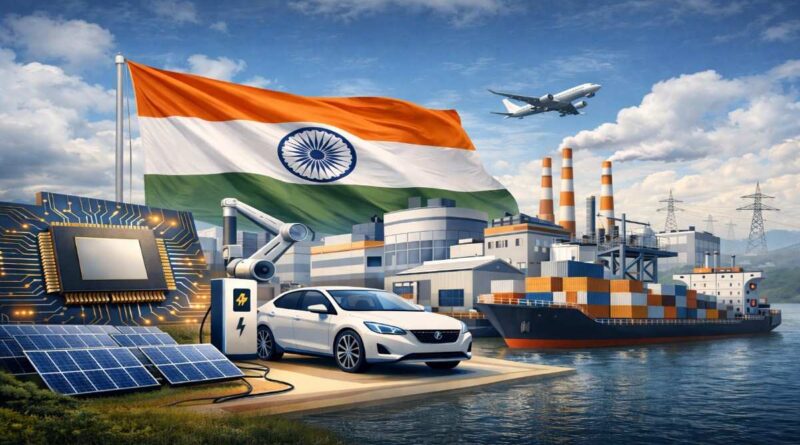
Production Linked Incentive Scheme 2026: Assessing India’s ₹1.91 Lakh Crore Manufacturing Strategy
The Production Linked Incentive Scheme 2026 represents one of India’s most significant industrial policy interventions in recent decades. In 2020, India launched the Production Linked Incentive Scheme, committing ₹1.91 lakh crore across fourteen strategic sectors in an effort to reposition manufacturing at the centre of its growth strategy. The objective was clear: reduce import dependence, scale domestic production, strengthen exports and move India closer to a 25 percent manufacturing share in GDP.
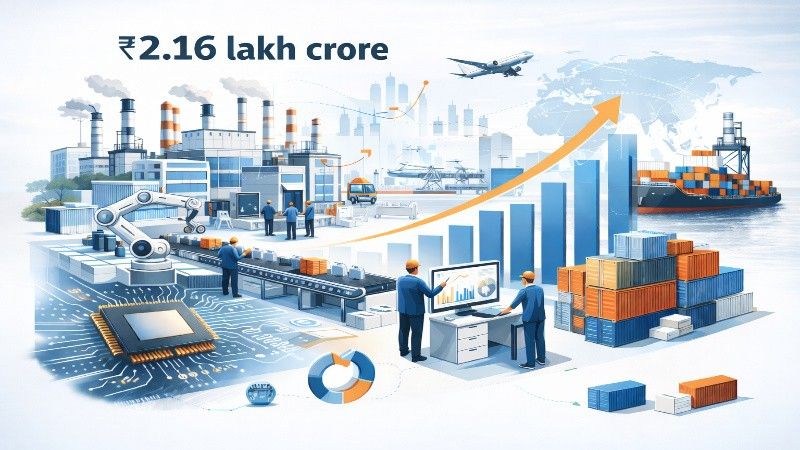
Six years later, the data offers measurable insight. Cumulative investment has crossed ₹2.16 lakh crore. Production and sales have exceeded ₹20.41 lakh crore. Exports stand at ₹8.3 lakh crore, and more than 14.39 lakh jobs have been generated.
The question is no longer whether the scheme has expanded output. The deeper question is whether it has initiated genuine structural transformation in India’s manufacturing ecosystem.
With a total approved outlay of ₹1.91 lakh crore across fourteen strategic sectors, the scheme seeks to increase domestic manufacturing capacity, deepen value addition, reduce import dependence and expand exports.
As of December 2025, according to official government data released by the Ministry of Commerce & Industry, measurable progress has been recorded.
836 applications have been approved.
Cumulative investment has crossed ₹2.16 lakh crore.
Production and sales have exceeded ₹20.41 lakh crore.
Exports have reached ₹8.3 lakh crore.
More than 14.39 lakh direct and indirect jobs have been generated.
₹28,748 crore has been disbursed as incentives.
These numbers indicate scale. The deeper question is whether they reflect structural transformation.
The Structural Context: Why the Production Linked Incentive Scheme 2026 Was Necessary
India’s manufacturing share remained around 15 to 17 percent of GDP for decades, significantly below major industrial economies. Domestic firms operated at lower value-added stages while importing critical components.
Three structural constraints shaped the need for reform:
• Low manufacturing share in GDP
• High strategic import dependence
• Weak integration into global value chains
India’s manufacturing push has also been supported by broader fiscal reforms and policy announcements in recent years.
The Production Linked Incentive Scheme 2026 was introduced to address these systemic limitations through performance-based incentives tied to incremental output.
Evolution of the Scheme: 2020 to 2026
The scheme began in 2020 with electronics and pharmaceuticals. It was gradually expanded to include automobiles, telecom, textiles, renewable energy, food processing and white goods.
Investment commitments accelerated in 2021 and 2022 as global firms diversified supply chains beyond China. By 2023 and 2024, production began scaling meaningfully, particularly in mobile manufacturing and electric vehicle components. By 2025, cumulative production crossed ₹20 lakh crore, signalling visible industrial expansion.
Industrial transformation, by nature, unfolds in stages. The timeline reflects sequential capacity building rather than immediate disruption.
Sectoral Assessment: Where the Impact Is Visible
Electronics Manufacturing
Electronics has emerged as the flagship success under PLI.
Mobile phone imports have declined by nearly seventy seven percent since financial year 2020 to 21. Today, over ninety nine percent of domestic demand is met through local production. Manufacturing has expanded beyond simple assembly to include printed circuit board assemblies, camera modules, batteries and display components.
This shift suggests movement up the value chain and deeper domestic value addition. Electronics exports now form a growing share of India’s merchandise exports.
However, advanced semiconductor fabrication and high end chip design remain external dependencies.
Pharmaceuticals and Medical Devices
Under the scheme, 191 bulk drugs are being manufactured domestically for the first time. Import substitution of approximately ₹1,785 crore has been achieved. Domestic value addition has reached 83.7 percent.
This strengthens supply chain resilience and reduces strategic dependence. The pharmaceutical ecosystem is becoming more self sufficient, though innovation driven research remains a long term priority.
Automobiles and Electric Mobility
The automobile PLI focuses on electric mobility and advanced automotive technologies. Reported sales of ₹32,879 crore in financial year 2025 to 26 demonstrate initial momentum. Investment in battery systems and power electronics indicates forward looking industrial positioning.
The sector aligns with global mobility transitions, although raw material sourcing and battery mineral dependency remain structural challenges.
Telecom and Networking Products
Telecom manufacturing sales have increased several fold compared to financial year 2019 to 20. Exports stand at ₹21,033 crore. Indigenous development of a full 4G technology stack signals technological capability expansion.
Beyond economics, telecom manufacturing contributes to digital sovereignty and strategic autonomy.
Renewable Energy and Solar Manufacturing
The scheme targets 48 gigawatts of fully integrated solar photovoltaic manufacturing capacity, supported by nearly ₹52,942 crore in investment commitments.
Given India’s renewable energy ambitions, domestic solar manufacturing reduces long term import dependence and strengthens energy security.
Macroeconomic Implications
From a macroeconomic perspective, the ratio between ₹2.16 lakh crore in investment and ₹20.41 lakh crore in production is significant. Manufacturing generates strong backward and forward linkages. It stimulates demand for steel, chemicals and intermediate goods. It strengthens logistics networks and formal employment. Export expansion contributes to foreign exchange stability.
Exports of ₹8.3 lakh crore under PLI supported sectors indicate improving global competitiveness.
At the same time, incentive disbursement of ₹28,748 crore against an outlay of ₹1.91 lakh crore reflects phased fiscal exposure. The performance linked design ensures that incentives follow verified output expansion.
Global Context: India Compared with China and Vietnam
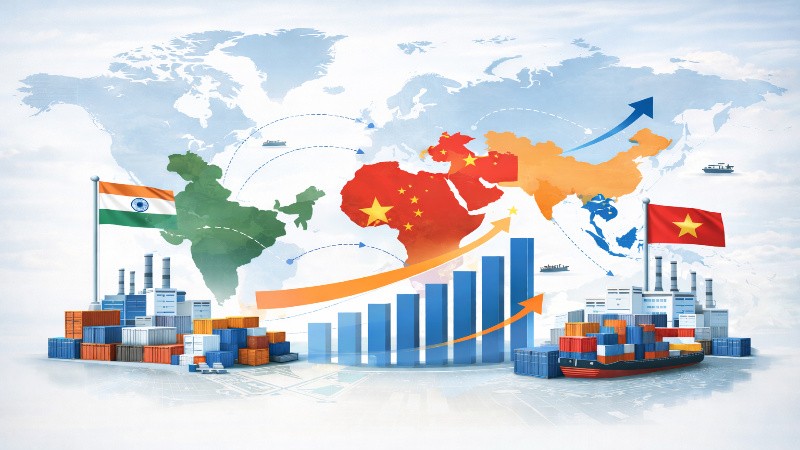
China’s manufacturing share exceeds 25 percent of GDP, supported by deep vertical integration and export driven scaling. Vietnam has emerged as a competitive electronics assembly hub with strong global value chain integration.
India’s approach differs. It leverages a large domestic consumption base while incentivising production expansion. Unlike unconditional subsidies, PLI ties state support to performance.
India does not yet match China’s integration depth or Vietnam’s export intensity. However, the scheme positions India as an emerging alternative manufacturing hub amid global supply chain diversification.
Employment and Structural Depth
The creation of 14.39 lakh direct and indirect jobs reflects positive spillovers. However, many PLI supported sectors are capital intensive, which moderates employment elasticity relative to investment size.
Long term transformation will require skill upgrading, technological innovation and deeper MSME integration into supply chains.
Manufacturing share in GDP remains below the 25 percent target. This suggests that structural consolidation is still in progress.
Critical Questions for the Next Decade
Several structural questions remain:
Will firms remain competitive once incentives phase out
Can India move decisively from assembly to innovation
Will infrastructure and logistics reforms keep pace with industrial expansion
Can manufacturing share sustainably approach 25 percent of GDP
Industrial history shows that transformation requires sustained policy continuity, not episodic interventions.
Outlook to 2030
If capacity expansion continues, manufacturing share could approach the mid twenties by 2030. Electronics, electric mobility and renewable energy manufacturing may become significant export pillars. Deeper semiconductor and advanced component ecosystems would accelerate value capture.
A moderate trajectory would see steady expansion but persistent high end component dependence. A weaker trajectory could emerge if global demand slows or ecosystem constraints limit scaling.
The direction will depend on productivity gains, technological upgrading and policy consistency.
Final Assessment
The Production Linked Incentive scheme represents a deliberate and performance oriented shift in India’s industrial policy architecture. It has mobilised substantial investment, accelerated production capacity and strengthened export presence across strategic sectors.
The data confirms that India’s manufacturing base is expanding. It does not yet confirm full structural transformation.
India is no longer debating whether to industrialise at scale. It has begun the process. The durability and depth of this transformation will be determined over the next decade. For now, the evidence suggests that the PLI framework has initiated a meaningful transition from import dependence toward structured manufacturing expansion.
FAQs
What is the Production Linked Incentive Scheme?
The Production Linked Incentive Scheme is a government policy launched in 2020 to encourage domestic manufacturing by offering financial incentives to companies based on their incremental production.
How much investment has the PLI scheme generated?
As of December 2025, the scheme has attracted cumulative investment exceeding ₹2.16 lakh crore across multiple strategic manufacturing sectors.
How many sectors are covered under the PLI scheme?
The Production Linked Incentive Scheme currently covers fourteen sectors including electronics, pharmaceuticals, automobiles, telecom equipment, textiles, solar modules, and food processing.
How much export growth has been supported by the PLI scheme?
Exports from PLI-supported sectors have crossed ₹8.3 lakh crore, reflecting stronger integration of Indian manufacturing into global supply chains.
How many jobs have been created under the PLI scheme?
The scheme has generated more than 14.39 lakh direct and indirect employment opportunities across different manufacturing sectors.
Why is the PLI scheme important for India’s economy?
The scheme aims to expand domestic manufacturing capacity, reduce import dependence, improve export competitiveness, and increase the share of manufacturing in India’s GDP.
People Also Ask
Which sectors benefit the most from the Production Linked Incentive Scheme 2026?
The Production Linked Incentive Scheme supports fourteen strategic sectors including electronics manufacturing, pharmaceuticals, automobiles and auto components, telecom equipment, solar photovoltaic modules, advanced chemistry cell batteries, textiles, and food processing. Among these, electronics manufacturing and mobile phone production have attracted the largest investment and export growth.
How does the Production Linked Incentive Scheme reduce import dependence?
The scheme encourages companies to expand domestic manufacturing capacity by offering incentives linked to incremental production. As firms scale production within India, dependence on imported components and finished goods gradually declines, strengthening domestic supply chains and improving trade balance.
What challenges could affect the long term success of the PLI scheme?
Despite strong early investment figures, the long term success of the scheme will depend on deeper integration into global value chains, technological upgrading, infrastructure improvements, and stronger participation of MSMEs in manufacturing supply networks.
