
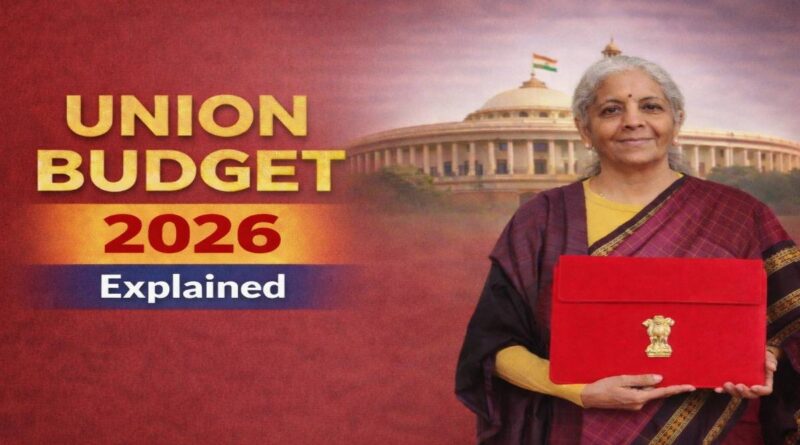
Union Budget 2026: Key Announcements and Impact on the Indian Economy
The Union Budget 2026, presented on 1 February 2026 by Finance Minister Nirmala Sitharaman, sets the economic and fiscal roadmap for India for the financial year 2026–27. The budget comes at a time when India remains one of the fastest-growing major economies amid global slowdown, geopolitical uncertainty, and volatile financial markets.
Union Budget 2026 focuses on investment-led growth, fiscal consolidation, strategic manufacturing, healthcare capacity, and policy stability. Rather than offering broad tax relief or short-term stimulus, the government has prioritised long-term economic resilience through capital expenditure and targeted sectoral interventions.
Key Announcements in Union Budget 2026
Summary of Major Announcements
| Policy Area | Announcement |
|---|---|
| Capital Expenditure | Rs 12.2 lakh crore for FY 2026–27 |
| Fiscal Deficit | ~4.3% of GDP |
| Gross Market Borrowing | Rs 17.2 lakh crore |
| Personal Income Tax | No change in tax slabs |
| Securities Transaction Tax | STT on futures & options increased to 0.05% |
| Semiconductors | India Semiconductor Mission 2.0 with Rs 40,000 crore outlay |
| Healthcare | Rs 10,000 crore Biopharma SHAKTI (5 years) |
| Education | One girls’ hostel per district; 5 university townships |
| States’ Tax Share | 41% of central taxes retained |
| Trade & Customs | Duty rationalisation and export input relief |
Exact Budget Changes and Announcements Explained
1. Capital Expenditure and Infrastructure Push
- Capital expenditure for FY 2026–27 has been raised to Rs 12.2 lakh crore
- This represents a double-digit year-on-year increase
- Priority sectors include:
- Roads and highways
- Railways and logistics corridors
- Power and renewable energy
- Urban infrastructure
The government continues its multi-year strategy of using public investment as the primary growth engine. Infrastructure spending has a high economic multiplier, supporting employment, private investment, and productivity growth.
2. Fiscal Deficit and Borrowing Strategy
- Fiscal deficit targeted at approximately 4.3% of GDP
- Gross market borrowing set at Rs 17.2 lakh crore
- Medium-term goal remains gradual fiscal consolidation
By keeping the deficit on a downward path while increasing capital spending, the government aims to balance growth needs with macroeconomic stability. This approach is intended to preserve investor confidence and control inflationary pressures.
3. Personal Income Tax: Unchanged
- No changes announced in personal income tax slabs
- Existing tax regime continues for salaried and middle-class taxpayers
- No new standard deduction or slab restructuring
The decision reflects fiscal caution. Instead of stimulating consumption through tax cuts, the government has chosen policy continuity and deficit control.
This outcome is broadly in line with the Budget 2026 expectations of middle-class taxpayers, which had indicated limited scope for major income tax relief.
4. Securities Transaction Tax (STT) on Derivatives
- STT on futures and options increased to 0.05%
- Applies to derivatives traded on recognised stock exchanges
The increase broadens the tax base from derivatives trading and signals regulatory caution toward excessive speculative and high-frequency trading, while leaving cash-market investors largely unaffected
5. Strategic Manufacturing: Semiconductors
- Launch of India Semiconductor Mission (ISM) 2.0
- Outlay increased to Rs 40,000 crore
- Focus areas:
- Semiconductor fabrication
- Equipment and materials manufacturing
- Chip design and intellectual property
- Supply-chain resilience
This marks a shift from assembly-led electronics manufacturing to high-value technology production, aimed at reducing import dependence and positioning India within global semiconductor supply chains
6. Healthcare and Pharmaceuticals
- Rs 10,000 crore allocated for the “Biopharma SHAKTI” programme
- Duration: five years
- Objective:
- Strengthen domestic biopharmaceutical manufacturing
- Support research and innovation
- Customs duty exemptions for select cancer and rare-disease medicines
The policy combines short-term affordability for patients with long-term capacity building in pharmaceutical manufacturing and research.
7. Education and Social Infrastructure
- One girls’ hostel to be set up in every district
- Five new university townships announced
- Focus on improving access to higher education and student housing
Investment in education infrastructure supports human capital development and aims to increase female participation in higher education
8. Trade, Customs and Exports
- Rationalisation of customs duty structures
- Higher duty-free input allowance for export-oriented sectors such as:
- Seafood processing
- Leather exports
- Plan for simplified digital cargo clearance systems
These measures aim to reduce input costs, improve export competitiveness, and streamline trade processes
9. Federal Fiscal Transfers
- States’ share of central taxes retained at 41%
- Applicable for the period 2026–31
Maintaining the tax devolution ratio provides predictability to state finances and supports cooperative federalism.
Sector-Wise Impact of Union Budget 2026
| Sector | Expected Impact | Reason |
|---|---|---|
| Infrastructure & Construction | Positive | Higher capex boosts demand and employment |
| Manufacturing & Technology | Positive | Semiconductor and strategic sector support |
| Healthcare & Pharma | Positive | Manufacturing incentives and duty relief |
| Financial Markets | Mixed | Higher STT affects derivatives trading |
| Salaried & Middle Class | Neutral | No tax relief, but economic stability |
| State Governments | Stable | Predictable tax devolution |
Overall Impact on the Indian Economy
Union Budget 2026 reinforces a long-term growth framework built on:
- Investment-driven expansion rather than consumption stimulus
- Fiscal discipline and controlled borrowing
- Strategic self-reliance in critical industries
- Human capital and healthcare development
With India’s GDP growth expected to remain among the highest globally, the budget aims to create durable economic capacity rather than short-term gains. This approach also aligns with India’s broader external economic strategy, including the recently finalised India–EU trade deal, which is expected to strengthen exports and global market access.
Conclusion
The Union Budget 2026–27 prioritises infrastructure investment, strategic manufacturing, healthcare capacity, and fiscal stability. While it offers limited immediate relief to individual taxpayers, it strengthens the foundations for sustainable and resilient economic growth.
For businesses and investors, Budget 2026 provides policy continuity and long-term opportunity. For the broader economy, it signals confidence in India’s growth trajectory amid global uncertainty.
Official Union Budget 2026 announcements are available via the Press Information Bureau

Pingback: Clean Max Enviro Energy IPO Review 2026: Should You Apply?
Pingback: Production Linked Incentive Scheme 2026 Analysis | India Manufacturing Growth
Pingback: Last-Minute Tax Saving Tips 2026: Save ₹1.5 Lakh Before 31 March
Pingback: UPI Fraud Alert 2026: New Scam Methods Reported Across India