
India–New Zealand FTA: A $2 Billion Opportunity to Replace Chinese Imports
Global trade is no longer driven only by low costs. Today, reliability, diversification, and supply-chain security matter just as much. In this changing environment, the proposed India–New Zealand Free Trade Agreement (FTA) has emerged as a significant opportunity for India.
As New Zealand looks to reduce its dependence on Chinese imports, India could potentially capture a $2 billion export opportunity, strengthening both economic and strategic ties between the two nations.
As countries like India expand their global trade partnerships seen earlier in the India–UAE trade agreement the proposed India–New Zealand FTA highlights India’s broader push to diversify exports and strengthen global economic ties.
What Is the India–New Zealand FTA?
A Free Trade Agreement (FTA) is a pact between two countries to reduce tariffs, simplify regulations, and improve market access for businesses.
The FTA discussions between India and New Zealand aim to:
- Lower trade barriers
- Encourage two-way investments
- Strengthen long-term economic cooperation
For India, this agreement offers access to a stable, high-income market with predictable trade rules.
According to official statements from the governments of both countries, the proposed agreement aims to deepen trade and investment ties between India and New Zealand.
Why New Zealand Is Reducing Dependence on Chinese Imports
For years, China has been a major supplier of manufactured goods to New Zealand. However, recent global disruptions have exposed risks such as:
- Over-dependence on a single country
- Supply chain disruptions
- Strategic and geopolitical uncertainties
As a result, New Zealand is actively diversifying its import sources—and India is well-positioned to step in.
Where the $2 Billion Opportunity Comes From
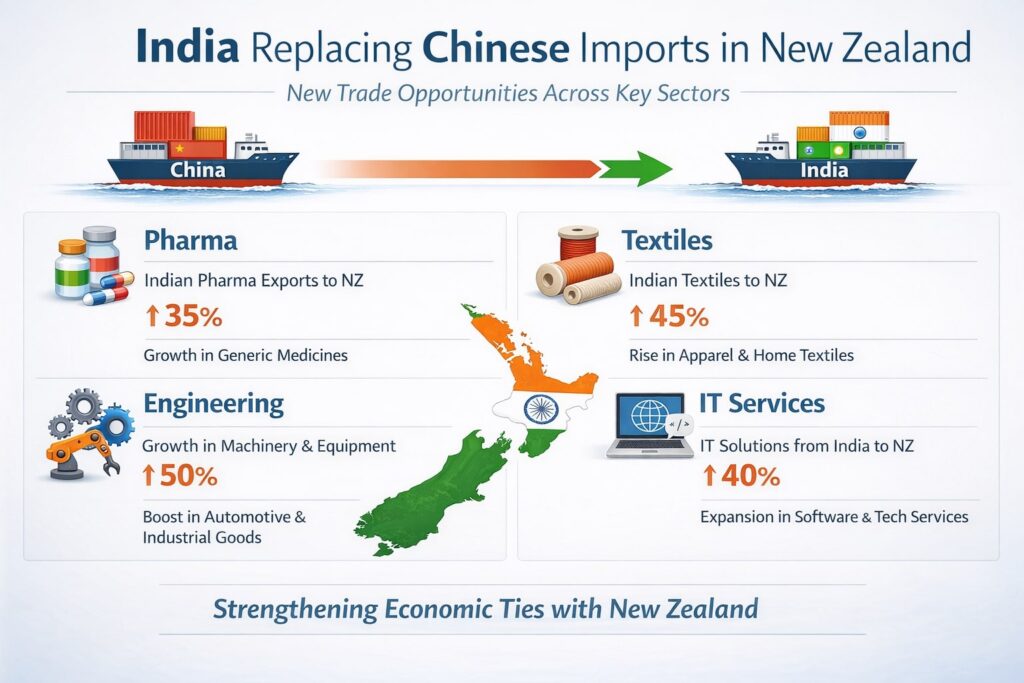
The estimated $2 billion opportunity reflects imports that New Zealand currently sources from China but could gradually shift to alternative suppliers like India.
Key Sectors Where India Can Replace Chinese Imports
- Pharmaceuticals & medical supplies
- Textiles and apparel
- Engineering goods & machinery components
- Automotive parts
- IT and business services
- Processed food and agricultural products
India already has strong capabilities in these sectors, supported by large-scale manufacturing and export experience.
Why India Is Well Positioned to Benefit
India’s export potential is backed by several structural strengths:
- Competitive manufacturing and labour costs
- A skilled workforce across manufacturing and services
- Strong MSME participation in exports
- Government support through Make in India and PLI schemes
An FTA would further improve price competitiveness by reducing tariffs and easing compliance requirements.
Challenges India Must Overcome
Despite the opportunity, replacing Chinese imports will not be automatic. Indian exporters must address:
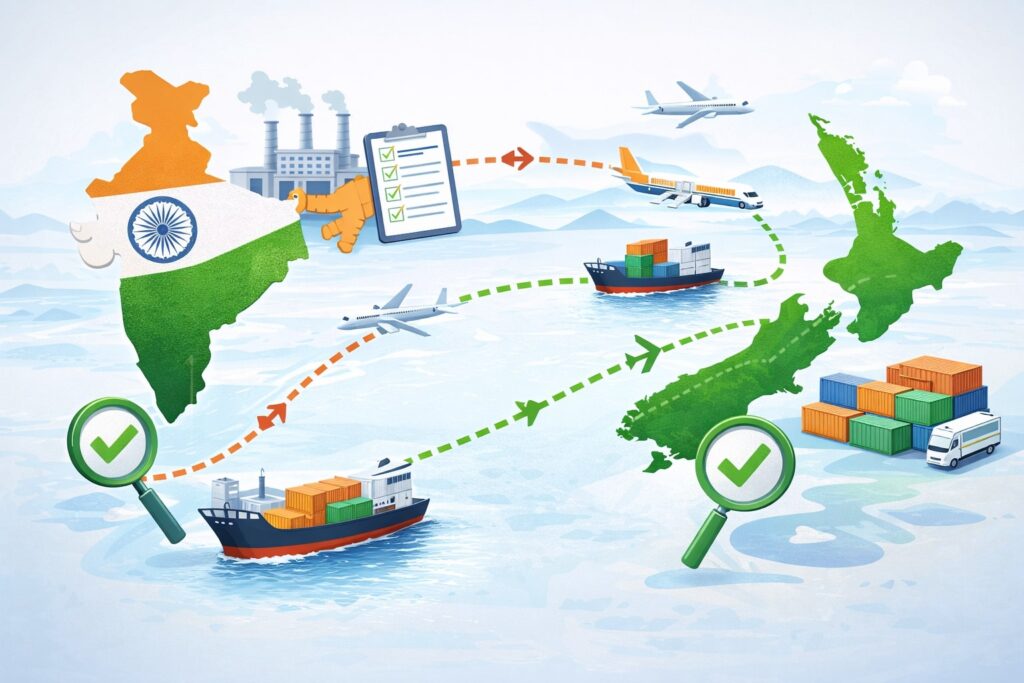
- Strict quality and regulatory standards
- Longer shipping routes and logistics costs
- The need for consistent and timely supply
- Competition with China’s scale and speed
How effectively these challenges are managed will determine the long-term success of the trade shift.
Strategic Importance Beyond Trade Numbers
The India–New Zealand FTA is not just about exports. It supports India’s broader goals:
- Strengthening the China-plus-one strategy
- Expanding India’s role in the Indo-Pacific region
- Enhancing credibility as a reliable global supplier
- Encouraging Indian companies to diversify export markets
Such agreements help India move up global value chains rather than competing only on cost. What This Means for Businesses and Investors
For Indian businesses:
- Exporters gain access to a high-income, stable market
- MSMEs can tap niche opportunities
- Predictable trade rules improve long-term planning
For investors, stronger trade integration signals structural strength in India’s export ecosystem, especially in manufacturing and services.
Long-Term Outlook
Capturing a $2 billion opportunity is realistic, but sustaining it will require:
- Continuous quality upgrades
- Efficient trade infrastructure
- Policy consistency
- Active participation from Indian exporters
If executed well, India can establish itself as a long-term alternative to China, not only for New Zealand but for other global markets as well.
Conclusion
The India–New Zealand FTA reflects a broader shift in global trade priorities—from dependence to diversification. For India, this agreement presents a timely chance to replace Chinese imports, expand exports, and strengthen its position in global supply chains.
While challenges remain, the economic and strategic benefits make this FTA an important step in India’s evolving trade strategy.
Stay informed on global trade, economy, and policy.
Explore more in our Economy section for clear, easy-to-understand insights on how international developments impact India.
